



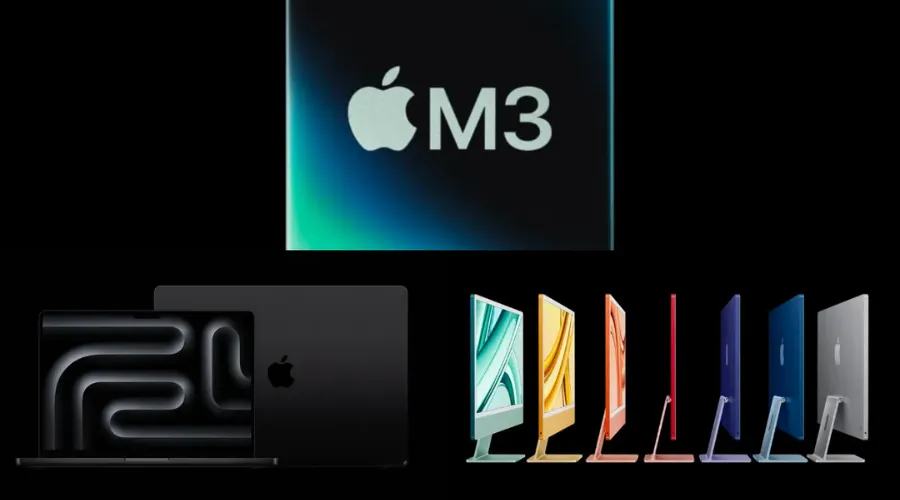
Apple has made a significant leap in its processor technology with the launch of the Apple M3 chip, alongside its variants – the Apple M3 Pro and Apple M3 Max.
The surprise announcement came during the Apple Scary Fast event in late October, defying earlier predictions that hinted at a release not before 2024. Unlike their conventional strategy of spaced-out releases, Apple revealed three formidable processors at once, promising unparalleled specifications and performance, marking a groundbreaking achievement in Apple’s processor lineup.
1. What is an Apple M3 chip?
Apple’s latest M3 chip falls in performance ranking below the M3 Pro and M3 Max but promises notable advancements from its predecessors, the M2 and M1. This series marks Apple’s first use of a more efficient 3nm process in its Mac chips.
The M3 family boasts remarkable performance enhancements, with Apple claiming up to 2.5x faster rendering than the M1 and 1.8x faster than the M2. Notably, GPU performance sees a significant boost, nearly doubling that of the M1 while consuming half the power. Compared to a 12-core PC laptop chip, Apple asserts the M3 delivers twice the relative GPU performance at a fifth of the power.
In terms of specifications, the M3 flaunts 25 billion transistors, an 8-core CPU, a 10-core GPU, and up to 24GB of unified memory. It supports a single external display.
A prominent feature of the Apple M3 is Dynamic Caching, integral to its substantial graphics enhancement. This technology dynamically allocates local memory, resulting in increased GPU utilization and overall performance improvement, according to Apple.
2. Top features of Apple M3 chip you must know
Here are the top features of the Apple M3 chip that you must know:
1. Faster CPU and GPU Performance
The M3 features an improved 8-core CPU and up to 12-core GPU which provide significant boosts over the already fast M1 and M2 chips. Expect at least 20% faster CPU performance and 50% faster graphics.
2. Enhanced Neural Engine
The 16-core Neural Engine on the M3 excels at machine learning tasks. Paired with the faster CPU and GPU, it should enable much faster ML workflows.
3. Leading Manufacturing Process
The M3 utilizes an enhanced 3nm process for improved power efficiency and higher performance compared to the 5nm process on prior chips. Lower nanometers aid faster processing.
4. Power Efficiency
Despite substantial speed gains, the M3 chip continues Apple custom efficiency cores to enable excellent battery life of up to 20 hours for portables like the next MacBook Air.
5. More Memory Bandwidth
The M3 provides 50% more memory bandwidth via a better LPDDR5 memory controller, allowing the chip to feed data faster for optimized performance.
6. Upgrades to the Media Engine
Expect superior media playback and capabilities for graphics and video professionals with enhancements to the media engine like dedicated ProRes encode/decode.
With big gains across processing, graphics, efficiency, and memory access, the M3 brings noteworthy improvements while upholding Apple’s reputation for outstanding mobile chips.
3. Step into the future of technology with the best-in-class performance of the Apple M3 chip
The latest Apple M3 chip is packed with notable specifications. Sporting an 8-core CPU architecture akin to the M2 chip, the M3 outpaces its predecessors in speed. This leap in performance is fueled by its groundbreaking 3nm design, a first in consumer-grade processors, offering 25% more transistors—25 billion versus the M2’s 20 billion.
While specific clock speeds for the M3 are yet to be disclosed, the M2 peaked around 3.5GHz, indicating an anticipated significant speed boost. Apple claims the M3 to be 35% faster than the M1 and an 18% improvement over the M2 in CPU performance, ensuring a clear generational leap. Similar to its predecessors, the M3 boasts a maximum of 24GB of unified memory.
Despite these performance enhancements, Apple assures a similar battery life to the MacBook Pro with the M2 chip, emphasizing the M3’s improved energy efficiency.
However, the most significant divergence lies in the M3’s GPU. Introducing hardware-accelerated ray tracing, mesh shading, and Dynamic Caching, Apple elevates its GPU capabilities. Dynamic Caching optimizes memory allocation, promising substantial enhancements in GPU-heavy tasks such as gaming and 3D rendering.
4. What’s new about three Apple chips launched recently?
Apple unveiled a trio of new chips falling under the umbrella of the M3 series, succeeding the current M2 generation. The lineup includes an entry-level M3, a speedier M3 Pro boasting a 40% performance boost, and the powerhouse M3 Max tailored for AI developers and 3D artists, promising a staggering 250% performance leap.
Apple emphasizes the M3 chips’ remarkable energy efficiency, boasting an impressive 22 hours of laptop battery life across the lineup. The M3 features an 8-core CPU paired with up to a 10-core GPU, while the Pro variant steps up with a 12-core CPU and an 18-core GPU. Meanwhile, the M3 Max sets a new benchmark with a robust 16-core CPU and an impressive 40-core GPU, targeted at AI software development.
Apple proudly touts the M3 series, asserting that its GPUs outperform the previous M2 chips by 1.8 times. In terms of CPU performance, the M3 processors showcase a 15% speed improvement over M2’s heavy workload performance and a substantial 60% leap compared to the M1 chip.
The groundbreaking chips are constructed using a cutting-edge 3nm process, representing the pinnacle of semiconductor manufacturing technology, courtesy of Taiwan Semiconductor Manufacturing Company (TSMC). The M3 Max machines are slated for a later November release, showcasing Apple’s commitment to driving innovation and performance in the tech landscape.
5. Apple M3 Chip Vs M2 Chip: Which one is better out of the two?
Here is a comparison of the Apple M3 Chip versus the M2 Chip to determine which one is better:
1. Performance & Speed
The M3 is clearly faster, with its 8-core CPU expected to be around 20% quicker than the M2. The 12-core GPU in M3 models is over 50% faster. So for both processing and graphics, the M3 has a strong edge.
2. Neural Engine
The 16-core Neural Engine on the M3 far surpasses the 16 cores in M2 for machine learning. So for ML apps, M3 is the obvious winner.
3. Power Efficiency
Both M3 and M2 chips utilize advanced power efficiency, but the M3 leverages a leading 3nm process for improved battery life. M3 may have slightly better efficiency.
4. Memory & Bandwidth
The M3 brings major improvements with 50% more memory bandwidth versus M2, allowing for better performance. M3 also utilizes fast next-gen LPDD5 memory.
5. Media Engine
While both have advanced media engines, the M3 adds capabilities like ProRes encoding and decoding which video editors need. M3 leads for media workflows.
In short, while the M2 is highly capable, the M3 brings substantial CPU, GPU, and memory access gains for both accelerated performance and efficiency. So the M3 clearly delivers meaningful progress over M2 for a better overall chip. The M3 is superior across most areas and workloads.
| Feature | Apple M3 Chip | Apple M2 Chip |
| Manufacturing Process | Cutting-edge 3nm process | 5nm process |
| CPU | Up to 8 high-performance cores Up to 4 efficiency cores | Up to 8 high-performance cores Up to 4 efficiency cores |
| CPU Performance | ~20% faster than M2 | – |
| GPU Cores | Up to 12 cores | Up to 10 cores |
| GPU Performance | Over 50% faster than M2 | – |
| Neural Engine | 16-core | 16-core |
| Media Engine | Upgraded with ProRes encoder & decoder | Advanced media engine |
| Memory Bandwidth | 50% higher than M2 chip | – |
| Battery Life | At least equal to the M2 chip | Up to 20 hours of video playback |
| Main Benefits | Faster processing Higher graphics throughput Enhanced machine learning More memory bandwidth | Great all-round performance Leading power efficiency |
In summary, the M3 chip offers significantly improved performance, graphics, media capabilities, and efficiency versus the already very fast M2 chip.
ALSO READ : Everything You Need To Know About The Upcoming Macbook Air M3
Conclusion
Apple’s latest upgrade, the M3, puts forth an impressive suite of refinements intended to heighten performance across hardware and software. An 8-core CPU built for agility in intensive tasks; a 10-core GPU architectured to catalyze immersive graphics capabilities; and the option of a generous 24GB of instant-access unified memory—external display support in tow. But sheer numeric upgrades only scratch the surface of innovation fortifying the M3.
A standout lies within its Dynamic Caching—an intuitive capability programmed to watch active workflows, then reapportion on-processor memory where situational need outpaces static allocation. For example, when the GPU tackles increasingly complex rendering demands, Dynamic Caching augments its local memory allotment in real time. This fluid versatility makes the most of existing hardware, dynamically hunting down and eliminating potential bottlenecks before they swell. For more information on Apple M3 Chip, visit Findwyse.